Hola Lake Immeln
The Hola Lake – Immeln project aims to answer why toxic algal blooms have started to appear in Lake Immeln during the autumn for the past eight years and why the lake's water has gradually become more and more brown in color for about 20 years. The project is a transnational collaboration with three Finnish organizations working with lake restoration.
About the project
The transnational project Hola Lake (Holistic Approach in Lake Restoration) aims to improve the ecological status of lakes by developing lake restoration methods with a holistic approach. This concept means that both internal and external inputs are considered, that is, both what happens in the lake and in its tributaries. The project includes both joint and local activities.
Immeln was a lake with clear water at the end of the 20th century. Today, the lake's water has turned brown and in the autumns, blooms of toxic cyanobacteria occur. The increased browning leads to a deterioration in water quality because the oxygen in the lake decreases due to the browning. This means poorer habitats for crayfish and fish, among others. The toxic algal bloom can also be dangerous to the organisms in the lake but also for, for example, dogs that drink from the lake water. The cause of both problems is not clear and there is no consensus among researchers or lake restorers on how to address the problems. There are also limited field studies that have aimed to find out the causes of the problems. The local activities in Skånes Ess therefore consist of field studies in Immeln and its tributaries to investigate brownification and nuisance algae.
Together with the three Finnish organizations Lake Vesijärvi Foundation, the Western Uusimaa Water and Environment Association and the Pyhäjärvi Institute, five workshops will be organized with different themes to discuss problems for lakes, jointly try to understand more about the processes in the lakes and come up with appropriate remedial measures. A synthesis of best practices on each theme will be prepared and simple instructions for citizens and landowners will be developed. The transnational cooperation will provide a fruitful arena for sharing information, successful methods and generating new ideas to develop the most effective methods for lake restoration.
The main objectives of the transnational project Hola Lake are to:
- Increase knowledge and improve methods to reduce external loads on lakes.
- Streamline methods for managing fish stocks.
- Improve the local and commercial use of caught fish.
- Increase understanding of the cause of mass development of invasive/nuisance algae and the measures that can prevent blooms of these algae.
- Improve knowledge and methods for handling reeds.
- Increase the use of harvested reeds as a raw material.
- Increase knowledge and involvement of local people in lake monitoring.
- Increase cooperation between local residents and surrounding organizations.
- Increase international cooperation and create professional networks.
Within the national part of the project, there is cooperation between the following organizations: Immelsjöns Fiskevårdsområdesförening, Osby Municipality, Östra Göinge Municipality and Skräbeåns Vattenråd. During the course of the project, it may be relevant to have a dialogue with, for example, the Swedish Forestry Agency, the County Administrative Board and local heritage associations, depending on the results generated.
Results
The project carried out water investigations with regard to chemical, physical and biological factors. Six workshops, five of which were in Finland. Five documents were produced as part of the Swedish-Finnish cooperation. These will be published by Finland's equivalent of the Nature Conservation Agency (SYKE).
The project discovered that there are connections between white bog species, bog drainage, spruce fields, browning, algal blooms and anoxic bottoms. The fact that a small species on a bog can affect an entire ecosystem through its acidifying effect shows how sensitive an ecosystem can be.
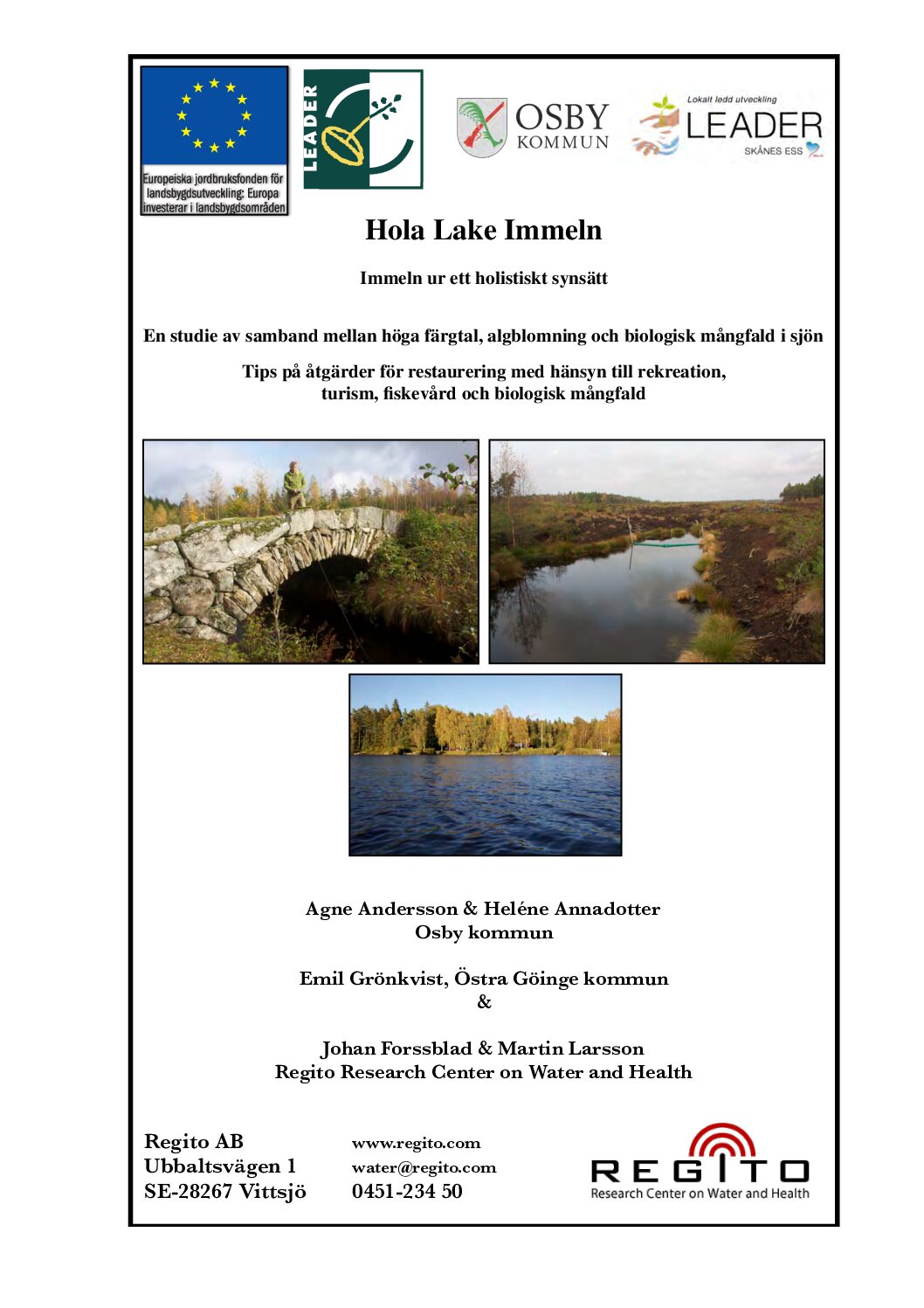
Read the project report by clicking on the image below!
Program period
2014-2024
Leader area
Skåne Ace
Journal number
2017-2038
Project owner
Osby municipality
Project period
Project type
Collaboration projects
Transnational project
Area of operation
Land/Water
Collaboration partners
Immelsjöns Fisheries Conservation Area Association
Osby municipality
Östra Göinge Municipality
Skräbeån Water Council
Agricultural Fund for Rural Development
Project support from EU funds
SEK 626,561
Public support from LAG
SEK 308,605
Total financing
SEK 935,166
Value of the project's non-profit efforts
SEK 121,000

A well-developed project application with clear problem statements and a clear focus on what the project aims to do, namely to find the cause of Immeln's browning and algal bloom. This is to be done through a competent working group of people with extensive experience in, for example, ecology, fisheries and water conservation, molecular biology and nature conservation together with Finnish partners with long experience in lake restoration. The results of the analyses benefit many both nationally and internationally, both housing, tourism, and plant and animal life, in the search for answers to the increased browning and algal bloom in lakes and increases the possibility of being able to take future measures to once again have healthier lakes. The project is a natural and good continuation of other projects around Immeln.